Play-Based Therapy: Why Kids Learn Best Through Play
Play is more than fun — it is how children learn to communicate. Discover why play-based speech therapy is so effective and what it looks like in practice.

If you have ever watched a toddler completely absorbed in stacking blocks, narrating a tea party, or chasing bubbles across the yard, you have witnessed something remarkable — a child learning. Not from a worksheet or a flashcard, but through the most natural thing in the world: play.
As a pediatric speech-language pathologist, play is not just a warm-up to the "real" work of therapy. Play is the work. And there is a wealth of research to back that up.
What Is Play-Based Therapy?
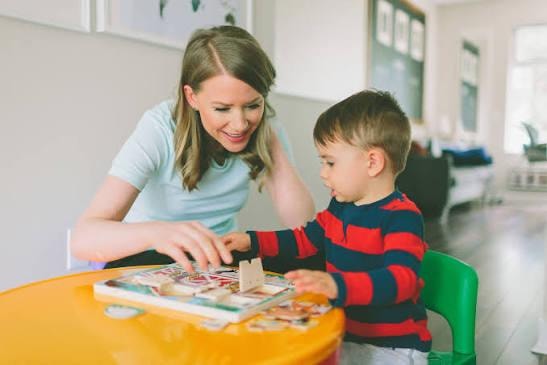
Play-based therapy is an approach to speech and language intervention that uses a child's natural love of play as the vehicle for learning. Instead of sitting at a table drilling words or repeating sounds on command, children engage in meaningful, enjoyable activities — and communication goals are woven naturally into every moment.
This might look like:
- Building a block tower together while practicing requesting ("more!" or "my turn!")
- Playing pretend kitchen to target vocabulary and sentence structure
- Blowing bubbles to work on early sounds like /b/ and /p/
- Reading a favorite book to build listening comprehension and narrative skills
- Racing toy cars to practice turn-taking and social communication
The activities change. The child's interests lead the way. But the goals are always intentional and always present.
Why Play Works: The Science Behind It
Children's brains are wired for play. Research in developmental psychology and neuroscience consistently shows that play activates the same brain regions involved in language, memory, problem-solving, and social connection.
Here is why play-based learning is so powerful for speech and language development:
1. Play Reduces Anxiety and Increases Engagement
When a child is relaxed and having fun, their brain is in the optimal state for learning. Anxiety and stress — which can easily arise in a more formal, structured setting — actually interfere with language processing and memory. Play naturally lowers those barriers.
A child who is giggling over a silly puppet is far more likely to attempt a new word or sound than one who feels put on the spot.
2. Play Creates Authentic Communication Opportunities
Real communication happens when there is something worth communicating about. Play creates those moments organically — a child wants to ask for the red crayon, announce that the dinosaur is eating the farmer, or tell you that the baby doll is "all done."
These are not manufactured prompts. They are genuine communicative intentions, and that makes them far more meaningful and memorable.
3. Play Supports the Whole Child
Speech and language do not develop in isolation. They are deeply connected to cognitive development, social-emotional growth, motor skills, and sensory processing. Play naturally addresses all of these areas at once.
When a child plays, they are practicing attention, problem-solving, creativity, and emotional regulation — all of which support communication development.
4. Play Builds the Therapist-Child Relationship
Trust matters enormously in therapy. A child who feels safe, seen, and genuinely enjoyed by their therapist is going to work harder, take more risks, and make faster progress.
Play is one of the most powerful ways to build that relationship. When I get down on the floor and follow a child's lead — letting them be the expert on their favorite toys and games — I am sending a clear message: I see you. I enjoy you. This is a safe place.
What Play-Based Therapy Looks Like in Real Life
Parents sometimes wonder: "Is my child actually making progress if they are just playing?" The answer is a resounding yes — but it helps to understand what is happening beneath the surface.
During a play-based session, I am constantly:
- Modeling language at and just above your child's current level
- Creating opportunities for your child to communicate (rather than doing everything for them)
- Responding to and expanding on whatever your child says or attempts
- Practicing specific targets — sounds, words, sentence structures — within the natural flow of play
- Coaching you on strategies to use at home between sessions
A session might look like pure fun from the outside. But every activity is chosen with your child's goals in mind, and every interaction is a carefully crafted learning opportunity.
Play-Based Therapy Works Across All Ages
One of the beautiful things about play-based therapy is that it is not just for toddlers. The approach adapts as children grow.
- Toddlers (18 months – 3 years): Sensory play, cause-and-effect toys, simple pretend play, and interactive routines
- Preschoolers (3 – 5 years): Imaginative play, board games, art activities, and shared book reading
- School-age children (6 – 12 years): Card games, building projects, storytelling activities, and interest-led conversations
- Older children and teens: Collaborative projects, role-play scenarios, and activities tied to their passions
No matter the age, the principle remains the same: children learn best when they are engaged, motivated, and having fun.
The Role of Parents in Play-Based Therapy
You are your child's most important communication partner — and play-based therapy is designed with that in mind.
At the end of every session, I share simple, practical strategies you can use at home during everyday play. Because here is the truth: the 30 to 60 minutes we spend together each week are valuable, but the hundreds of hours you spend with your child every week are where real, lasting progress happens.
When parents learn to follow their child's lead, narrate what they see, and create space for communication during play, the results are remarkable.
Is Play-Based Therapy Right for My Child?
Play-based therapy is appropriate for most children receiving speech and language services, including those with:
- Speech sound delays or disorders
- Language delays (expressive and/or receptive)
- Late talking
- Autism spectrum disorder
- Social communication difficulties
- Stuttering (fluency disorders)
- Voice concerns
If you are wondering whether your child might benefit from speech therapy, I offer a free developmental milestone screener on this site — it is a great first step.
The Bottom Line
Play is not a break from learning. For children, play is learning — and it is the most powerful kind.
When therapy feels like play, children show up ready to engage. They take risks, try new things, and build skills without even realizing they are working. And that joy? That confidence? It carries far beyond the therapy session and into every conversation, every classroom, and every connection they make.
If you have questions about play-based speech therapy or would like to learn more about services for your child, I would love to connect. Reach out today — I am here to help your child find their voice! 💚
Explore Topics
Written by
Lauren Bialkoski, M.S., CCC-SLP
Content creator and writer sharing insights and stories.